Field-Tested, Real-World Lessons [No Games] for Transforming Teams from Storming to Performing

Overview: Maria’s 12-Month Team Turnaround That Worked
Maria, a newly promoted leader, inherited an underperforming team that came with a clear goal: to restore performance in 12 months. She quickly realized the team suffered from an internal governance failure, not broken people.
This article is fictional, but it is grounded in decades of real-world experience, and every transformation detail reflects scenarios that truly happened. It details how Maria partnered with James, an RMT facilitator, to implement the Right-Minded Teamwork (RMT) 5 Element Framework.
Learn how they systematically used
- Work Agreements, a collaborative
- Operating System, and a
- Teammate Development workshop
to move the team from blaming and victimhood to sustainable accountability, ultimately achieving a permanent turnaround and establishing a new organizational best practice.
This story is an invitation to leaders: see how creating emotionally mature teams is the most effective way to start a ripple effect of positive change in your community and the world by adopting RMT’s philosophy of Do No Harm, Work as One.®
Take your time reading this story and avoid skimming, as the detailed, embedded lessons will clearly reveal why the RMT approach, a field-tested method, is the more effective and sustainable way to build high-performing teamwork.
And remember, this is just one application. Once you are familiar with all the tools, you will easily discover that you can apply them just-in-time in any fit-for-purpose application.
Table of contents
- Overview: Maria’s 12-Month Team Turnaround That Worked
- The 12-Month Turnaround
- Part II: Planning the Transformation
- Part III: Building the Team’s Foundation
- Part IV: Strengthening the Transformation
- Part V: Team Results and Bill’s Congratulations
- Yours is the Next Chapter: Start Right-Minded Ripples in Your Teams and Change the World
RMT Context: The Backstory
The organization Maria worked for was an international public company with ninety thousand employees. Three years earlier, James, the RMT consultant, had facilitated a Work Agreements workshop there for an eight-person leadership team, of which Maria was a key member. Her boss, Roger, had strongly felt that Agreements would mitigate the stress, conflicts, and tension during the upcoming ERP installation of a company-wide accounting system.
Roger was right. The installation was extremely complex, but his team never lost its composure. They successfully navigated major technical problems by adhering to the Work Agreements they had created nine months before the go-live date. Their exemplary behavior under stress was attributed directly to their willingness and ability to act on those agreements. That success was the beginning of a working relationship between Maria and James.
James’s Journey to Right-Minded Teamwork
After earning his master’s degree, James gained valuable Human Resources and team facilitation experience, eventually leaving to start his own consulting practice. At the end of his first year as an entrepreneur, he became dissatisfied. The team-building tools he had been trained to use resulted in workshops that succeeded, but the gains were not sustained.
He began searching for a better way.
A colleague recommended Right-Minded Teamwork and its core process element, Work Agreements. James studied and applied the RMT methods, quickly realizing the simple power of co-creating behavioral and process agreements. After his first year of facilitating Agreements workshops, James had solid, personal evidence that they worked. He saw firsthand that Work Agreements taught teammates how to genuinely Do No Harm and Work as One—a philosophy he has now championed and practiced for ten years.
PDF Article: Click Here to Download
The 12-Month Turnaround
Part I: The Challenge
Maria didn’t apply for the job. She was chosen.
Her reputation for calm leadership and collaborative success had preceded her. Because she had experienced the Right-Minded Teamwork process with the ERP team three years earlier, she was now being asked to lead a team that had never known anything like that terrific example of collaboration.
Bill, her soon-to-be manager, was direct and spoke frankly with Maria in his office.
This team has lost two customers. Their performance metrics have declined steadily. It was a difficult decision, but I’ve decided that their current leader, Don, who has led the team for two years, will be terminated. I need someone who can turn this team around in twelve months, and that person is you.
Maria didn’t flinch. She asked questions. She learned about the team’s history and the patterns of finger-pointing, blame, and avoidance. She discovered that the two supervisors, George and Linda, had stepped into the leadership vacuum with aggression and divisiveness.
Maria didn’t believe they were broken people; she thought it was a broken system. She concluded that the team wasn’t merely bruised; it was suffering from a complete failure of internal governance and shared vision. They needed structure, they needed right-minded accountability, and most of all, they needed to talk to each other, not about each other. This was a classic case that required the Right-Minded Teamwork (RMT) approach she had used before.
Bill was candid about his own missteps. “Maria, I wasn’t clear enough with Don. I didn’t set expectations early. I won’t make that mistake again.” He promised Maria full support.
Bill’s Expectations and Maria’s Strategy
Bill shared the biggest lesson he learned from the situation.
I believe that I was not clear enough with Don and his team about what I expected of them. Therefore, when I introduce you, their new team leader, I will tell them that I expect this team’s performance to return to its pre-Don metrics, and the team needs to accomplish that within the next twelve months.
Bill added, “I will say that you have my full support and that I expect every team member to get behind you and follow your lead. Failure to reach those goals is not an option.”
Maria accepted the job and the challenge. She knew the job was tough but not impossible, and the challenge motivated her. Bill asked her to take a long weekend off to reflect, reset, and prepare. She had not yet met the team, but she knew what they needed: clarity, connection, and a genuine belief that the path forward would succeed.
🔹 The Team’s History and Dysfunction
The team consisted of ten teammates, including two supervisors.
There was a legacy of missed opportunities. Don, their leader, had been well-meaning but ineffective. His indecisive leadership had created a vacuum, and the two supervisors, George and Linda, had filled it with force rather than focus. Their behavior—arguing, undermining, and triangulating—had become normalized. The team had fallen into a storming state and were stuck there.
Maria’s first insight came from her private orientation session with Bill. He described the team as “not severely toxic,” but Maria sensed deeper fractures. She knew that unresolved interpersonal issues could sabotage even the best teamwork processes and systems.
She also knew that leadership wasn’t about fixing people, but about creating the conditions where people could choose to improve, consciously and compassionately, working together as one unified team through the RMT Do No Harm, Work as One philosophy.
Maria realized that under Don’s leadership, the team had devolved into a Battleground, where conflict was personal and punitive. Her strategy, supported by James, was to transform that environment into a Classroom, where mistakes led to learning and growth.
She began forming a strategy.
It would start with listening to each teammate and then moving to strengthening the operating structure. She would meet each person individually, understand their roles, and assess their readiness. Then, if needed, she would bring in James, the Right-Minded Teamwork facilitator who had helped the ERP team succeed three years earlier.
🔹 How Maria Was Introduced to the Team
On Tuesday morning, November 1, the day the leadership change would happen, Maria arrived at work early.
Bill met with Don privately to handle the termination with dignity. Meanwhile, Bill’s assistant gathered the team in the conference room. They were unaware of what was about to unfold.
Bill entered the conference room while Maria waited outside. Bill delivered the news to teammates with compassion and clarity. They were surprised, but not shocked. He acknowledged the team’s struggles and announced that Maria would be their new leader.
Bill opened the door, and Maria stepped in.
She didn’t pretend to have answers. She acknowledged the surprise, shared her background, and promised to spend the next two weeks learning before making changes. She emphasized the team’s mission, their shared opportunity, and the belief that they could succeed together.
Then Bill stated his expectations: performance must return to previous levels within twelve months. He would support Maria fully, and he expected the team to do the same.
Maria then asked, “Do any of you have clarifying questions for Bill before he leaves?”
George spoke first. “I believe it’s possible to return to our old performance, but I predict we’ll have to make more changes.”
Linda added, “Yeah, George, and there may be changes YOU might not like.”
Maria noted their tone of voice and the inferences. She had been warned about their personalities, but now she saw the raw, divisive dynamics firsthand. After the meeting, she spoke privately with Bill. “They’re more volatile than I realized,” she said. Maria knew she’d need to act quickly.
🔹 Maria’s First Turnaround Steps
Maria spent her first week in deep conversation.
She met with each team member, clarified the team’s mission, and took deliberate but small baby steps to begin rebuilding trust. She quickly recognized the behavioral patterns:
- avoidance
- triangulation
- passive resistance
She knew, from previous experience, that teammates who fight among themselves eventually lose.
By the end of the week, Maria had made up her mind to call James, the RMT facilitator. She believed that her decisive leadership, combined with James’s facilitation expertise, would significantly increase the team’s chances of a successful twelve-month turnaround.
When she called him, he was excited to learn of her new assignment and was happy to help. They agreed to meet at her office in two days.
Maria committed to leading decisively, but collaboratively. She would hold people accountable in a safe and supportive way, while inviting them to own their growth. She would model the RMT principles she wanted the team to embrace, especially the Do No Harm, Work as One philosophy.
Part II: Planning the Transformation
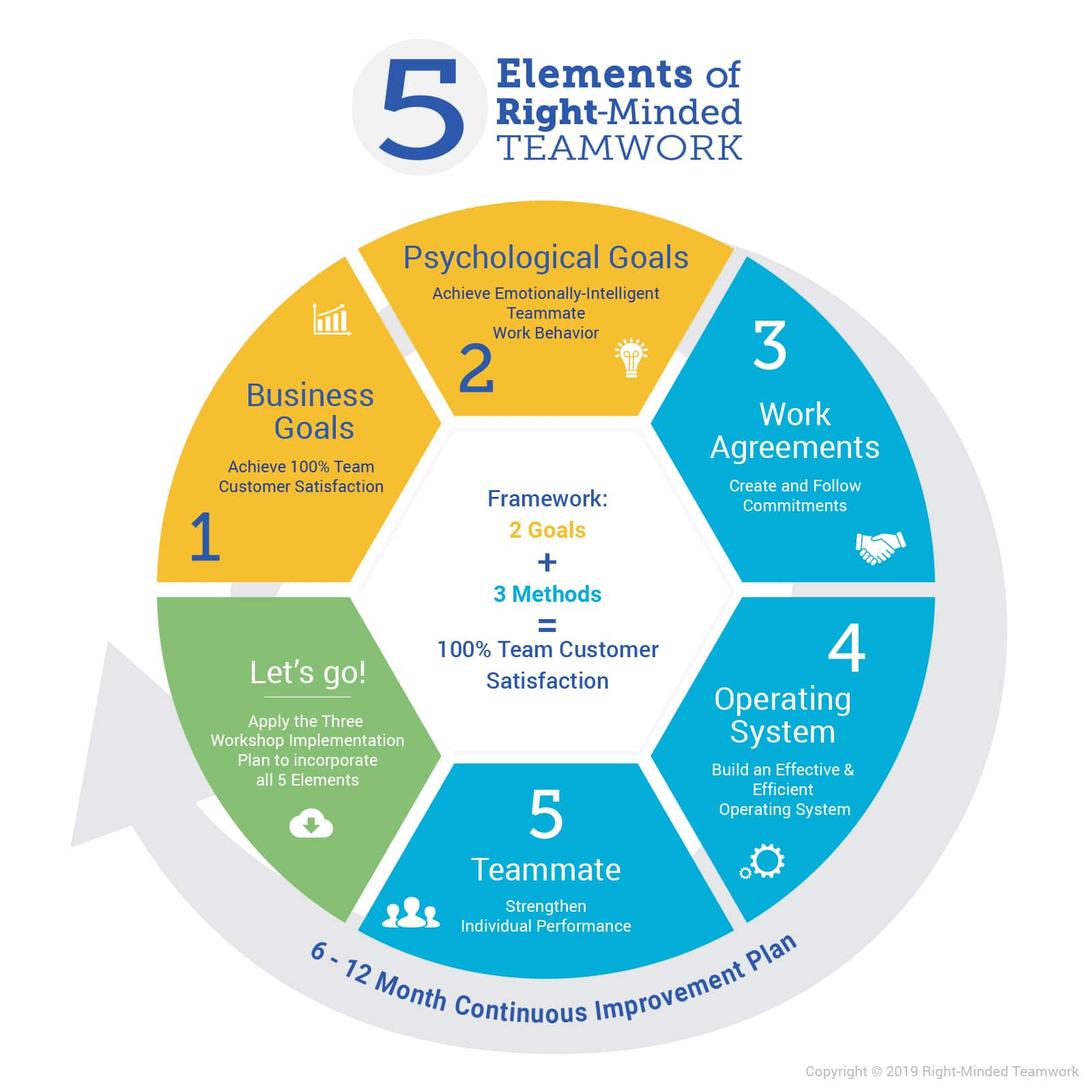
The entire transformation process for Maria’s team would be anchored in the RMT 5 Element Framework:
- Business Goal: Achieve 100% Customer Satisfaction.
- Psychological Goal: Right-Minded Thinking.
- Work Agreements: Teammates’ work commitments to one another.
- Team Operating System: Their 90-day continuous-improvement process.
- Teammate Development: Authentic, intentional growth plans for every member.
🔹 Revitalizing the Team’s Mission
In her first two weeks, Maria met individually with every team member several times. She asked about their lives, their roles, their frustrations, and their understanding of the team’s mission. Many responses were vague or defensive. A few blamed others. One was honest enough to admit they didn’t know what the mission was anymore.
Maria listened, clarified, and coached. She reminded each person that their work mattered, not just to the company, but to their customers.
She began using the phrase “Thrill our customers” as a rallying point.
This phrase aligned perfectly with Element #1, their Business Goal, and was one of the first steps in helping the team move from storming to norming.
Maria knew that individual coaching wasn’t enough. The team needed to talk to each other—not just to her. They needed to confront the triangulation, the gossip, and the passive resistance with compassion. They needed to build trust. And for that, Maria needed James’s help.
🔹 Team Interviews, the Punch List & the Three-Workshop Plan
Maria and James met on the following Tuesday, November 15.
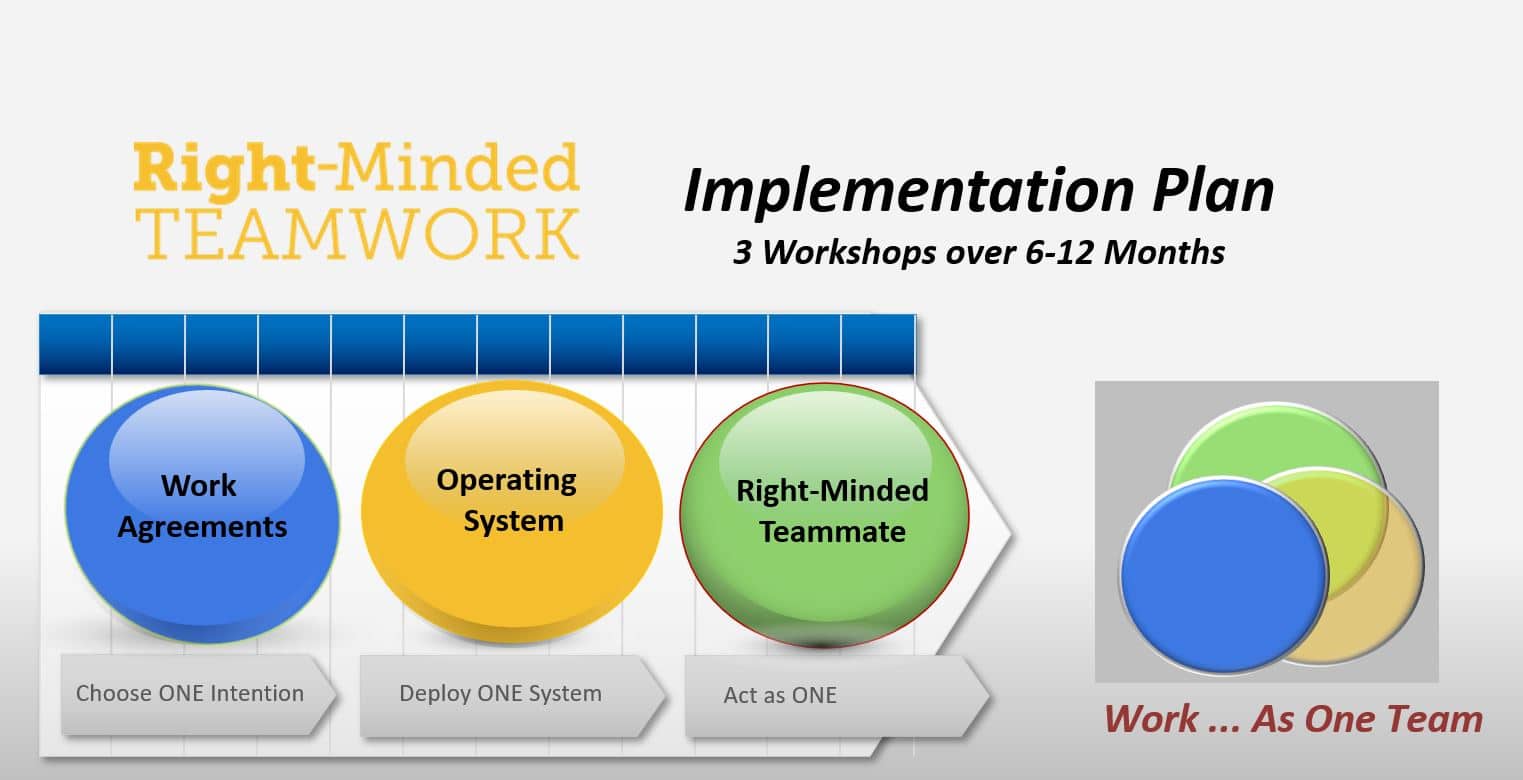
They created a strategy, using the RMT 5 Element Framework and the standard three-workshop Implementation Plan process. They agreed to conduct the following three workshops over the next seven months, aligning with the three action-oriented elements of the framework:
- Work Agreements Workshop (Element #3)
- Team Operating System Workshop (Element #4)
- Teammate Development Workshop (Element #5)
They agreed that Maria would continue her one-on-one coaching, while James conducted confidential, hour-long interviews with each team member. He would ask each person about communication, collaboration, accountability, and respect.
He completed all interviews and, on Friday, he synthesized the information into the team’s Punch List of improvement opportunities.
He presented the Punch List to Maria on Monday morning, which was a combined summary outlining teammates’ collective perspective of unresolved team performance issues. It included:
- Inconsistent decision-making processes and meeting ineffectiveness
- Lack of clarity in roles and responsibilities
- Poor communication protocols and practices
- Customer dissatisfaction and workflow inefficiencies
- Toxic interpersonal dynamics
Maria reviewed the Punch List and nodded approvingly.
“This is exactly what I’ve been seeing. Now, we need to get everyone into a positive mindset for the first workshop. When we co-create Work Agreements that directly address these issues, they will easily understand the value of the process. James, we’ve done this before, and we will do it again with this deserving group of people. Let’s prepare everyone.”
James created the meeting agenda, fine-tuned the Punch List, and created a simple preparation task list for teammates to complete before the workshop.
Maria distributed and explained those documents at their next weekly meeting. Everyone seemed to be clear, even though some were still anxious. Their first workshop was now only eight days away.
🔹 Weekly Team Meetings Begin; 1st Performance Factor Assessment
In the first weekly meeting on November 22, Maria announced the team would participate in RMT team-building workshops. She explained the general plan would include three workshops and that they would eventually create and follow a 90-day Team Operating System. Their first workshop would be held on December 8, where they would create Work Agreements.
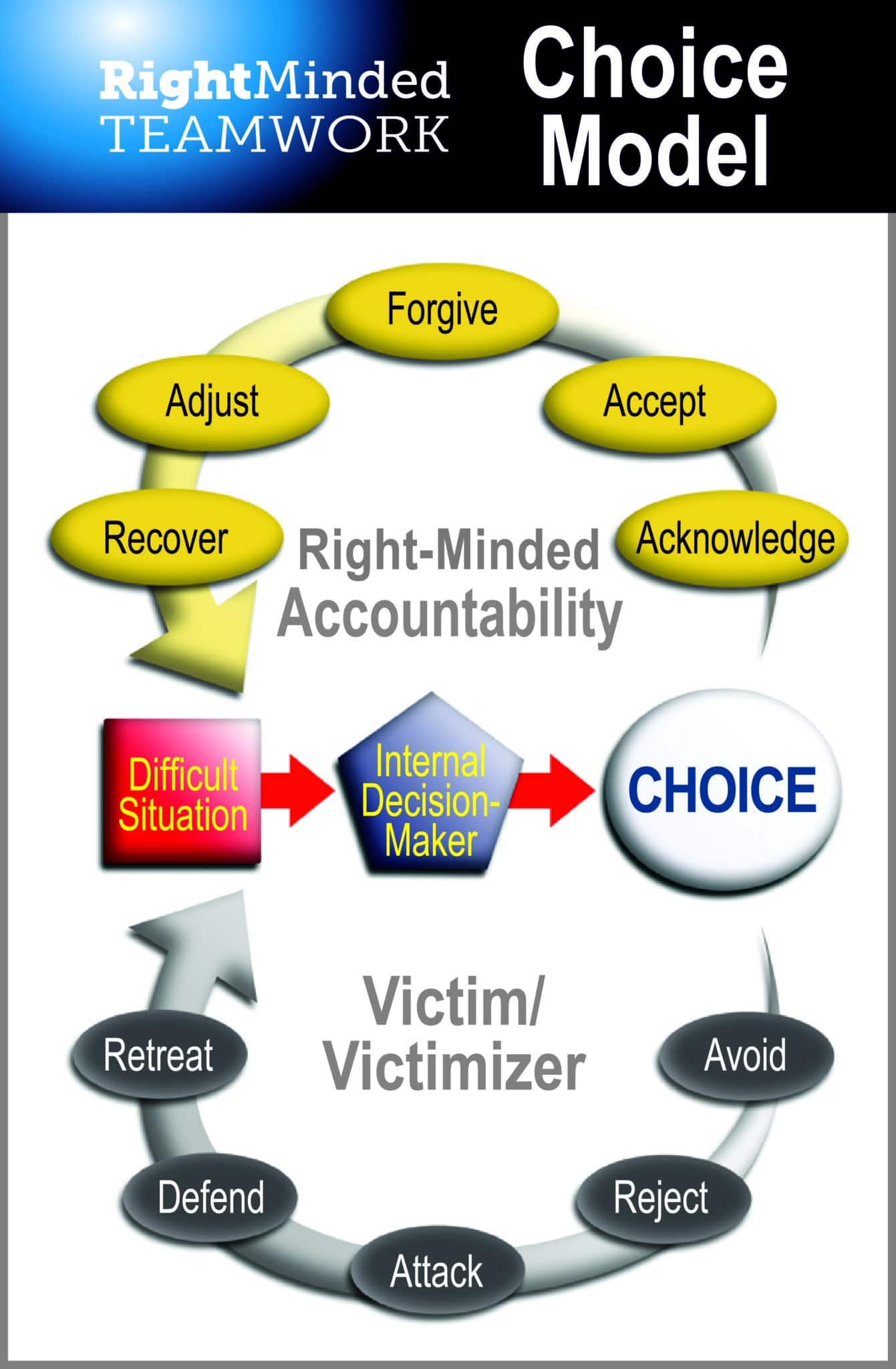
Maria made it clear that the success of the agreements hinged on their mindset. She introduced the core teaching of the Right Choice Model, explaining that every teammate always has two choices: either react defensively (Ego/victimhood) or choose Accountability (Reason/ownership). She challenged the team to use this framework to shift their thinking ahead of the December 8 workshop.
To prepare for the Operating System workshop on January 12, the team would conduct its first Team Performance Factor self-assessment. The assessment results would be used to help the team stay focused on the critical few tasks they collectively believed would help them achieve their performance goals. This assessment would be conducted every 90 days. She confirmed James would be facilitating the workshops.

🔹 The 1st Workshop: Four Work Agreements Created!
On December 8, two weeks after the final teammate interview and five weeks from when Maria started, the team gathered for its first RMT one-day Work Agreements Workshop (Element #3).
James facilitated. Maria participated, not as a distant leader, but as an equal. The nervousness quickly subsided when they started discussing the Do No Harm and Work as One philosophy, which embodies Element #2: Right-Minded Thinking.
The workshop began with a simple but powerful premise: each teammate was asked to agree to make accountable right-minded choices, while letting go of any lingering victimization attitudes. James presented the RMT’s Right Choice Model, which teaches that we only have two choices when difficult team situations happen: 1) to be accountable or 2) to be a victim.
James asked, “How would you like to approach your 12-month turnaround challenge?”
Most of them heartedly agreed, “Of course, we need to approach our situation with a right-minded, accountable attitude. Let’s get started.”
James knew they were now in the right frame of mind to address their issues. He introduced their collective task: to create Work Agreements that would directly address their Punch List issues. He explained that these agreements were their emotionally mature promises to each other about how they would behave. They were commitments made by the team, for the team.
For the remainder of the workshop, James guided the group through structured Punch List conversations.
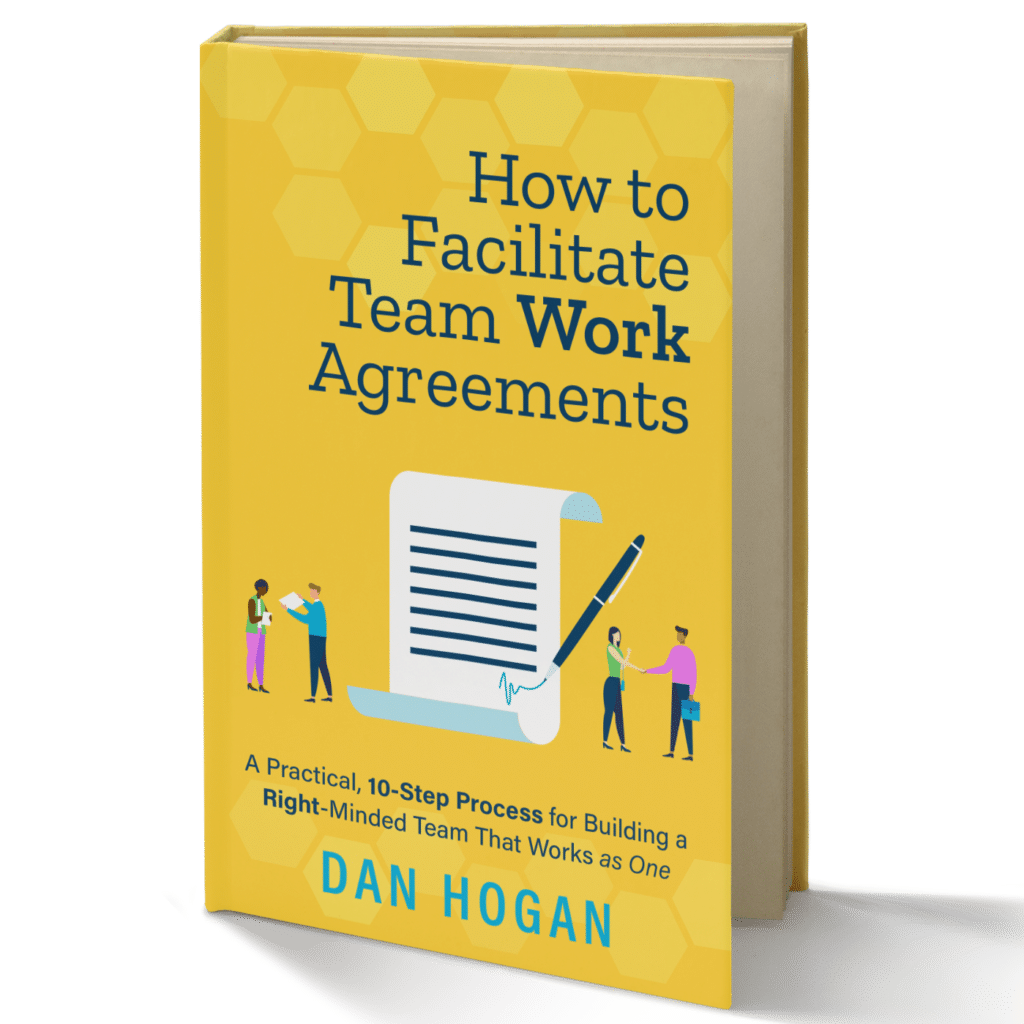
[To learn James’ “guiding” skills, see the RMT book: How to Facilitate Team Work Agreements: a Practical, 10-Step Process for Building a Right-Minded Team That Works as One.]
Some moments were tense. George and Linda heard difficult feedback. But Maria had prepared the team well, increasing their willingness to listen and find solutions.
Before launching into the agreements, Maria reinforced the Right Choice Model:
“It’s okay to disagree with one another and with me, but it’s not okay to behave in a disagreeable manner. We need to be respectfully honest with each other, especially if it helps our team meet or exceed our 12-month mission and achieve 100% customer satisfaction.”
Everyone agreed.
By the end of the workshop, they had created four critical Work Agreements that directly addressed four of the eight Punch List topics:
- Meeting Effectiveness
- Roles and Responsibilities
- Communication Norms
- Customer Satisfaction
The communication agreement was the most challenging, yet it led to powerful norms like: Listen to understand, and it’s ok to disagree, but not to be disagreeable.
Every teammate agreed that “…if we all actively live these agreements, we will improve our performance.”
Closing the Agreements Workshop: Gratitude, Partnership, and Momentum
The Agreements workshop was just about to end when Maria turned to James, in front of the others, and said, “Thank you very much! We could not have been this successful without you.”
The entire team gave James a round of applause. He smiled and communicated his deep appreciation, filled with joy that his methodology had again brought a positive contribution to people’s lives.
Maria went on to tell her team that although the day had not been easy, it was well worth the work. She announced that the work they had begun would continue with two more team-building workshops, with James as the facilitator. The next workshop would create and install a self-sustaining, continuous-improvement Team Operating System. The third would focus on strengthening Teammate Development.
Then she did something wonderful that genuinely surprised her team. She went around the room and briefly gave a special, heartfelt thank you to each team member for his or her positive contribution to the success of the Agreements workshop.
Maria closed with authority and gratitude:
“I trust you can see that our four agreements, together, define our collective promise to ourselves. Yes, we have more items to address on our Punch List, but let’s do these well for the next three months, and we’ll address the others at that time. Please remember: WHEN we all actively live them, we will Do No Harm and Work Together As One.”
There was a gasp in the room. Then George broke the silence and said, “You’re Right!” and everyone else, even Linda, agreed.
Maria adjourned the workshop and said goodbye as everyone, except James and Maria, left the room.
James thanked Maria, praising her partnership in planning and how well she modeled the behavior she wanted to see. “I have worked with many leaders over the years, and I believe you did one of the best jobs of preparing your team members that I’ve ever seen. By speaking with each one privately last week, you were able to lower their anxieties and increase their readiness to address issues. You must have been successful in mitigating their fears, because they were really ready to talk!”
Maria smiled with gratitude for the praise, and James knew that she understood the tremendous power behind having team members make their own agreements, because they were then more likely to live up to them after the workshop.
🔹 Agreement Review Moments: An Essential Sustainable Task
Maria knew from her experience that agreements made in a workshop could easily fade.
So, in the next team meeting, she began with a short Agreement Review Moment (ARM’s). She asked the team to reflect on one agreement, share examples of how it was being lived, or not, and recommit to it. They even edited and added to several agreements because it helped to clarify their original intent.
These review moments were brief but powerful. They kept the agreements in everyone’s right mind by reminding teammates that accountability wasn’t punitive; it was collaborative. The turnaround had begun—not just in performance, but in mindset.
Part III: Building the Team’s Foundation
With the emotional groundwork of the Work Agreements (Element #3) in place, it was time to build the team’s sustainable operating system (Element #4).
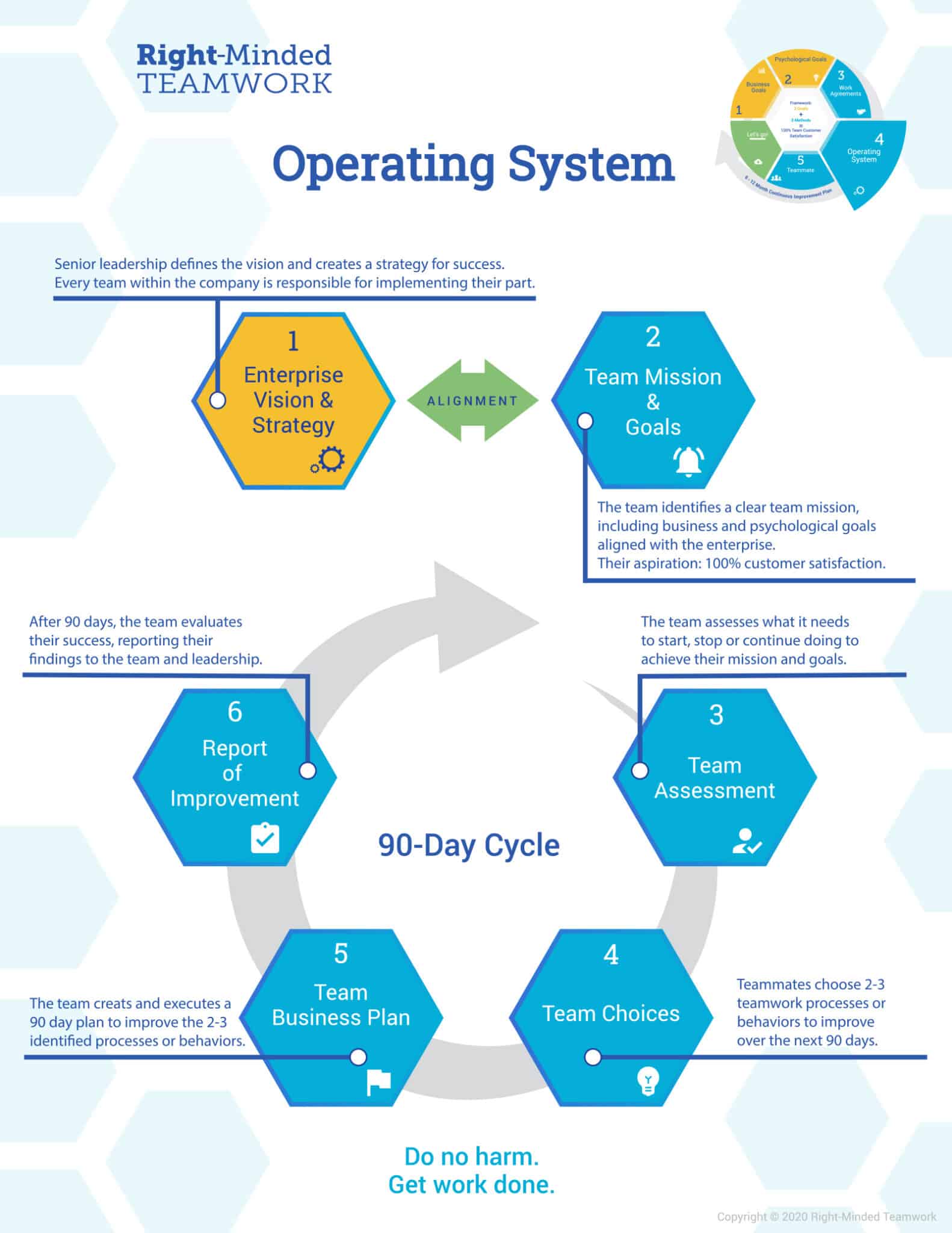
Maria and James met to plan that workshop, scheduled for January 12, five weeks after the first. This workshop would apply the fourth RMT element – the Team Operating System. It would introduce RMT’s standard operating model, a six-step framework for continuous improvement and self-sustaining collaboration.
The system includes the Team Performance Factor Assessment, a 25-factor tool perfectly aligned with the six steps of the operating system.
This assessment would be used every 90 days to help the team collaboratively identify and focus on the critical few tasks necessary to achieve their performance goals.
It would become a valuable team performance dashboard. James would assist the team in completing the first assessment one week before the January 12 workshop.
Maria also designated the January 12 event as their first Quarterly Team Meeting, a title that signaled both rhythm and relevance. She wanted to emphasize that the RMT three-workshop process was not a one-time event; it was the beginning of a sustainable teamwork system.
To prepare for the second workshop, Maria made a strategic move: she asked George and Linda to work with James to not only review and prioritize the Punch List items, but also to engage them in finding solutions versus finding fault. By involving the two most vocal team members in shaping the team’s operating system, Maria gave them essential ownership and accountability.
🔹 Workshop 2nd of 3: Installing the Team Operating System
The one-day, January 12 workshop was intense, practical, and transformative. James facilitated, and Maria co-led.
Maria was adamant that this structured rhythm was the mechanism for achieving Sustainable Transformation, ensuring that focus wasn’t lost after the initial workshop enthusiasm faded.
The team reviewed their Punch List and the Team Performance Factor Assessment results. With Linda and George’s facilitation support, the team prioritized their improvement opportunities into what they believed would have the greatest impact over the next 90 days (between now and the end of March).
The team agreed to focus on these five teamwork process improvement opportunities, forming their first 90-Day Tactical Business Plan:
- Improve their customer satisfaction using the RMT Customer Satisfaction Plan (directly supporting Business Goal, Element #1)
- Adopt RMT’s 6-step operating system; modify as needed
- Clarify decision-making protocols before making important decisions
- Continue to discuss and agree on teammate roles and responsibilities as needed
- Improve their meeting effectiveness and behavioral norms
Two sub-teams were immediately created, with every teammate assigned to one:
- Improving Customer Satisfaction (Focus Area #1): This team would conduct customer interviews, create a Customer Satisfaction Improvement Plan using RMT’s process, and report progress weekly. Goal: Final Plan agreement by January 31.
- Streamlining the Workflow Process (Focus Areas #2-5): This team would discuss and agree on how to successfully address the remaining four focus areas and present their recommendations for the entire team to vote on.
🔹 A Moment of Reason: Recommitting to the Agreements
Even with the best intentions, teammates can fall short of living their Work Agreements in the early days. What matters most is how the team responds and recovers.
Here’s what happened: When they were discussing decision-making protocols, one teammate began criticizing another’s ideas by dredging up past mistakes. The team fell back into their old ways—arguing, not constructively, and dishonoring their Communication Work Agreement.
James gently interrupted the bickering. He asked them to pull out their Work Agreements. After reading them silently, one teammate said with an embarrassed, “Ah ha” tone:
“We’ve already agreed how we were to discuss conflicting issues like this, haven’t we?”
James replied,
Yes. And let me remind you of the Right Choice Model’s teaching that you have only two choices. 1) Continue arguing like you used to, or 2) Recommit to your Communication Agreement and move forward toward a shared Operating System.
In less than a minute, they agreed to recommit. Several teammates apologized, and others kindly accepted. The room softened. It was the team’s first collective Moment of Reason. They chose to correct—not punish—the missteps, a perfect example of moving back into their right minds (Element #2).
This successful recovery proved the team was finally leaving the Battleground mentality behind. They were now operating as a true Classroom, using their Agreements to learn and grow stronger from every challenge.
This collective renewal was a victory for their long-term goal of Sustainable Transformation, demonstrating that their agreements could withstand real-world conflict. For the rest of the workshop, they maintained their new behavioral norms.
They agreed to continue meeting every 90 days to strengthen their Team Operating System and to assess team progress, recalibrate goals, and create new tactical plans. They easily agreed to conduct the second Team Performance Factor Assessment two weeks before their April 2 Quarterly Team Meeting.
Maria closed the planning session with a final reminder:
Creating a plan is easy. To follow through is key. A poor plan well executed will outperform a great plan poorly executed. But, we want to be sure we have a good plan and we execute it well.
🔹 Their Progress After 2nd Workshop
Maria continued her one-on-one coaching, focusing on accountability, giving support and praise, and respectful conflict resolution. She used real-time moments to teach. When someone triangulated, she addressed those moments privately, guiding teammates back to collaboration. When someone avoided responsibility, she asked, “Do you prefer to make something happen, or stand by and wait for something to happen?”
Meeting Effectiveness By January 15, the team implemented their new meeting agreement: bi-weekly, 60-minute meetings (not 90 minutes as before) with a standard agenda, and a shared online Action Item register.
Customer Satisfaction Plan On February 2, the Customer Satisfaction sub-team presented its RMT-based plan, which the full team agreed to implement. The core of the plan involved assigning two teammates to every customer to conduct structured interviews, asking five key questions to define expectations and identify gaps:
- What are the essential products or services you need from our team?
- What are your expectations of our team, and how does our team help you achieve those expectations?
- Where are we meeting or exceeding your expectations?
- Where are we NOT meeting your expectations?
- Is there anything we are giving you now that you do not need?
The goal was to complete all interviews by the end of February and begin actively implementing tailored Customer Satisfaction Plans by March 1.
🔹 Second Quarterly Team Meeting
On April 2, the team held its second Quarterly Team Meeting. Two weeks earlier, they conducted their second Team Performance Factor Assessment. In the three-hour meeting facilitated by James, they:
- Reviewed and assessed the progress in their first 90-Day Tactical Business Plan.
- Reviewed their second Assessment results.
- Discussed and agreed on their next 90-day plan, April to June.
- Confirmed the third Quarterly Team Meeting for June 2.
Bill attended for an hour and was impressed. “It looks like you’re on track to fulfill my expectation to turn around this team in twelve months. Congratulations. Keep up the good work—don’t let up.”
Some team members were still struggling, especially with the communication agreements, but overall, the team was moving in the right direction. They were talking more openly, collaborating more consistently, and beginning to trust the process and each other. Maria saw the shift—not just in performance, but in mindset. The team was beginning to believe in themselves.
Part IV: Strengthening the Transformation
🔹 Workshop 3rd of 3: Right-Minded Teammate Development

Maria, at this point, had led the team for nearly five months, and she believed they had made measurable progress. Their performance metrics were trending upward. Maria knew it was time for the third workshop – the fifth element of RMT’s 5 Element Framework – Teammate Development. This session, scheduled for May 15, needed to focus on strengthening individual growth, emotional intelligence, and the behaviors that elevate not just performance, but trust.
When Maria asked James for a recommendation, he didn’t hesitate: Let’s use the RMT exercise About Me and My Preferences. He assured Maria it would be a terrific first teammate development exercise because it was extremely simple and yet incredibly powerful.
In the April 15 bi-weekly meeting, Maria announced that this one-day workshop would be held in four weeks and that James would facilitate it.
She described the exercise: the goal is to increase the understanding of each other’s work preferences by answering this question: “The most productive way to talk and work with me is ….” Every teammate will share their answer in the workshop, and all teammates will ask clarifying questions.
She also said that before the workshop, she would meet privately with each person to assist them in preparing their answer if they wanted her support. Her coaching lowered anxiety and increased openness, just as it had before the Agreements Workshop. This preparation was essential, as the workshop would require the team to shift from a mindset dominated by Ego to one based on Reason.
🔹 Breakthroughs in Empathy and Emotional Maturity
This one-day teammate development workshop was on May 15.
It was transformative.
It gently forced the team to recognize that their constant arguments were driven by Ego—the need to be “right” and to maintain individual control. By sincerely sharing their preferences, they consciously chose Reason, prioritizing the team’s shared interests and understanding over their separate, conflicting agendas. George learned that Linda’s need for detail was, to her, a measure of her commitment, not an attempt to slow him or the team down. Linda learned that George’s abruptness occurred when he felt pressure to make a decision without considering all the facts. It was not a sign of disrespect. This shift reframed their conflict from a personal war into a manageable, visible style clash, creating the first genuine cracks in the team’s defensiveness.
As each person shared their answer, the room shifted. People learned things about each other that were obvious in hindsight, but had never been spoken aloud.
George’s sharing was a moment that stood out.
Everyone saw him as a fast, decisive analyzer. But George revealed that he didn’t like making decisions quickly. When pressured, he became reactive, sometimes aggressive. He admitted that he’d said things in the past he regretted, and he didn’t want to be that kind of leader anymore. He also said that their Communication Agreement meant a lot to him and that he was trying to do his best to live by that agreement.
His vulnerability changed the room.
Everyone, except Linda, believed him. They agreed to support him by giving him space to think before deciding. It was a turning point. George wasn’t just being heard; his preferences were being understood.
Maria reinforced the moment: “This is what it means to act as one. This is how we live the Do No Harm Work as One Philosophy. We don’t just work together, we grow together.”
🔹 Linda’s Crossroads: Resistance or Growth
Linda participated in the Teammate Development Workshop, but her engagement was subdued. Her shared answer lacked depth, and for some, it seemed hollow and insincere. She didn’t respond to George’s vulnerability, nor did she seem to engage with the team’s emotional shift.
Maria noticed. So did James.
They didn’t confront Linda directly, but they made space for her to choose. Maria, after the workshop, offered support, clarity, and accountability. But she didn’t force Linda to change. She knew that transformation had to be chosen, not imposed.
🔹 The 3rd and 4th Performance Factor Assessments
The team held its third Quarterly Team Meeting on June 2. The results of the third Team Performance Factor Assessment were clear: trust had improved. Communication was more respectful. Collaboration was more consistent. Team meetings were more effective, and many customers were giving unsolicited positive feedback. The team was no longer storming; they were norming, and in some performance areas, performing.
Maria announced the good news at the meeting. The room erupted in applause. Even Linda smiled—though her joy was muted.
The team held its fourth Quarterly Team Meeting on August 4. All the performance metrics had improved except for three that had slipped. One of the “slips” had to do with not meeting a customer’s expectation. When the team discussed the customer’s complaint, Maria’s team realized their internal approval process was too slow, which was the root cause. They spent two hours creating a process map and brainstorming solutions. They streamlined the process and immediately implemented the new process, and, in the end, the customer was completely satisfied.
🔹 The 5th Performance Factor Assessment
The team held its fifth Quarterly Team Meeting on October 15. The results of the Team Performance Factor Assessment confirmed that the team had achieved its performance goals. And now it was time to share the results.
Part V: Team Results and Bill’s Congratulations
🔹 Recognition and Resignation
It’s October 15. Eleven months and 15 days after Maria took over, Bill summoned the team to his conference room.
He began with candor: “I have some good news, and some not-so-good news.”
Linda had resigned that morning. She told Bill she couldn’t fit in with the team anymore. It was a quiet exit, but not a surprising one.
Then Bill turned to the team. “You’ve done it. You’ve returned to the performance levels I expected. I’m proud of you. I’m recommending that other team leaders model your Quarterly Meeting and Right-Minded Teamwork Agreement process. Your team system is a best practice in my opinion. You’ve shown us how a team can bond together and authentically Do No Harm and Work as One.”
The room erupted in genuine applause.
Maria hadn’t sought recognition, but she welcomed it. Her team had earned it.
🔹 A Worthwhile Lesson Learned
There’s a valuable lesson in Linda’s statement that “she couldn’t fit in with the team anymore.”
Even though Bill and Maria could sense this truth, it was James who named it clearly: when a team culture heals and becomes emotionally mature, like this team did, anyone who doesn’t participate in that change will feel more pain because they can’t act like a victim any longer.
Here is where the Right Choice Model’s lesson of “you only have two choices” concept is clearly seen. For Linda, her two choices were to:
- change and be more accountable to “fit in” or
- leave so that I do not have to change.
In this case, she decided to leave.
🔹 A Year Later: Maria’s New Promotion and George’s Rise
Maria stayed with the team for another year, focusing on institutionalizing their success.
She continued to lead with clarity, compassion, and accountability, refining the team’s Operating System and coaching individuals to sustain their progress. As Bill proudly shared their achievement, Maria’s success became the organizational blueprint: she was often asked to help other team leaders implement her RMT processes and the “Work as One” philosophy. This growth also brought more business to James, who found himself facilitating workshops for many other teams within the company.
Maria’s Promotion
Then came her next opportunity: a promotion to lead the company’s Asia/Pacific region, headquartered in Singapore. Maria accepted, viewing the challenge as a chance to scale the RMT principles.
She was particularly delighted to learn that the Right-Minded Teamwork framework was actively supported in the region. James explained that the Facilitators Network Singapore had, two years prior, sponsored RMT certification training events, resulting in several RMT-certified facilitators whom she could call on for regional support and collaboration.
Bill noticed.
When the company prepared for a major acquisition, Bill recommended George to the CEO to lead the Merger & Acquisition team. George accepted and delivered. The acquisition became the most profitable in the company’s fifty-year history.
Before leaving, George groomed two successors. One of those, Mohammad, he recommended to take his place, and he led the team for the next three years. The Right-Minded Teamwork system remained intact. The team continued to thrive.
They had become a Right-Minded Team, a group of teammates who continue to this day to Do No Harm and Work as One.
Yours is the Next Chapter: Start Right-Minded Ripples in Your Teams and Change the World
Maria’s story is fictional, but the transformation is real.
It mirrors hundreds of teams I’ve worked with over the past 40 years—teams that struggled, healed, and thrived using Right-Minded Teamwork principles. If you’re a facilitator, team leader, or someone who believes in the power of collaboration, this story is your blueprint.
The tools Maria and James used—Work Agreements, the 5 Element Framework, Agreement Review Moments, and the “About Me and My Preferences” exercise—are not proprietary secrets. They are practical, teachable, and available to you.
Right-Minded Teamwork is not a one-time fix. It’s a philosophy and a system.
It’s about creating emotionally mature teams that choose:
- Accountability over victimhood.
- Collaboration over conflict.
- Purpose over politics.
- And of course, right-mindedness over wrong-mindedness.
You don’t need to be perfect. You need to be willing—willing to listen, to lead, and to model the behaviors you want your team to embrace.
We all see and hear daily reports of conflict, division, and harmful behavior on the public stage. Our work in our teams will not change those headlines, but it can absolutely change the lives of the people we work with. We can heal the relationships around us, creating a right-minded ripple effect that extends far beyond the office—into our families, our communities, and our organizations.
The truth is simple: it’s to everyone’s benefit to think and act right-mindedly.
When more and more of us do, we are doing our part to create a more loving world where people work—and live—Together as One
Maria’s 12-Month Team Turnaround Timeline
| Date | Event |
| November 1 | Maria begins her new team leader role. |
| November 15 | Maria meets James to plan. |
| November 22 | First weekly team meeting: RMT workshops announced. |
| December 8 | 1st Workshop: Work Agreements |
| December 15 | First Agreement Review Moment (ARMs) |
| January 6 | 1st Team Performance Factor Assessment |
| January 12 | 2nd Workshop: Team Operating System |
| January 15 | First bi-weekly meeting. |
| February 20 | Completed team customer interviews. |
| March 1 | Created Customer Satisfaction Plan. |
| March 20 | 2nd Team Performance Factor Assessment. |
| March 31 | Completed the first 90-day Tactical Business Plan period. |
| April 2 | 2nd Quarterly Team Meeting. |
| May 15 | 3rd Workshop: Right-Minded Teammate Development. |
| May 25 | 3rd Team Performance Factor Assessment. |
| June 2 | 3rd Quarterly Team Meeting. |
| July 25 | 4th Team Performance Factor Assessment. |
| August 4 | 4th Quarterly Team Meeting. |
| October 5 | 5th Team Performance Factor Assessment. |
| October 15 | 5th Quarterly Team Meeting. |
| Official 12-Month Turnaround Completion. Performance exceeds the mandate. Team is stabilized and celebrated. | |
