🙏 Stop being a “referee.” 👉 Start demonstrating the way.
Strengthen marginal behaviors into a reliable Behavioral Engine. Don’t use silly games to fix team friction. To achieve operationalexcellence and mutualaccountability, you need and want WorkAgreements, your custom moral contracts that empower your teammates to self-regulate during all team situations. Watch: 46-Second Explanation Video.
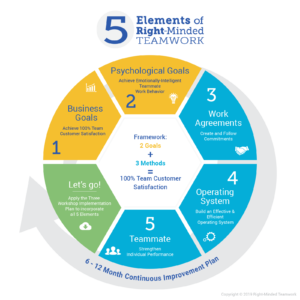
If your team is “stuck” despite having great goals, you are likely missing RMT’s Element #3: The Work Agreement. Without this element, your team lacks the necessary accountability engine to turn aspirations into sustainable performance.
The Work Agreement: Your Sustainable Performance Engine
Too many teams do not have agreements, and others rely on flimsy “ground rules” that are posted on a wall and forgotten. But in the Right-Minded Teamwork (RMT) framework, these successful teams create and live Work Agreements: their custom Moral Contract.
These agreements are emotionally mature, collective promises that teammates make to each other. They are the team’s engine by defining how teammates, during difficult team situations, will act and behave. Creating and living Work Agreements is the foundation of true operational excellence.
Better Pricing: Direct orders are often cheaper than Amazon and ship immediately from our publisher, IngramSpark. As an Amazon Associate, we earn from qualifying purchases.
I’ve put together a “Look Inside” sample featuring the Table of Contents, two very practical sections on the two agreement types, and an expanded narrative overview of the 10-steps.
A Narrative Overview of the 10-Step Process
The journey begins with Step 1: The Business Mission and Step 2: The Psychological Goal, where you define the “what” and “how” of the team’s existence. This ensures the agreements are not just a list of rules, but a strategic tool for achieving 100% Customer Satisfaction.
The process then moves into the Identification Phase (Steps 3-4). Here, the team identifies the specific work processes and interpersonal behaviors that are currently not working as they should. By naming these “Lower Loop” habits in a safe, structured environment, you clear the way for Steps 5-7: Drafting the Agreements.
At this time, you will facilitate the creation of Process Agreements to clarify such things as roles and Behavioral Agreements to define how teammates agree to act while performing their roles.
Finally, the process concludes with Steps 8-10: Commitment and Sustainment. This is a critical part of the engine. You don’t just “yes, I agree”; you lead the team through a commitment discussion and install an interlocking accountability condition for acceptance. Every teammate agrees to “Accept, Forgive, and Adjust” their attitudes and behaviors thus ensuring that team accountability becomes a self-regulating habit that persists long after the initial workshop.
Sustainment
A common mistake is thinking the work ends when the agreement is created. I’ve dedicated a portion of this book to the Sustainment Phase. You will learn how to help teammates self-regulate. When the team owns the agreements, the leader is finally freed from the “referee” role. This shift allows you to move from micromanagement to true leadership, fostering a culture where high-performance teamwork is the natural byproduct of a well-tuned engine.
The Power of Proof: A $350,000 Turnaround
Work Agreements aren’t theory; it’s a field-tested process. This book includes the case study of a Field Operations team. They achieved:
$350,000 in measurable cost savings through improved efficiency.
78% increase in teammate trust.
61% increase in compliance with team decisions.
100% Customer Satisfaction ratings within 12 months.
Who Should Use Work Agreements?
This methodology is designed for facilitators and team leaders who are serious about establishing psychological safety at work. If you are responsible for navigating high-stakes transitions or rebuilding trust in a fractured department, these 10 facilitation steps provide the professional process you need to facilitate Work Agreements that will achieve high-performance teamwork.
What’s Included in This Exclusive Digital Package:
The Complete Guide: (266 pages) Comprehensive facilitation instructions in PDF and ePUB.
Facilitator’s Resource Guide: (54 pages) Infographic models and facilitation tips.
Reusable Word Templates: (14 pages) The exact tools I use in my workshops so you can implement this system of team accountability immediately.
3 reviews for How to Facilitate Team Work Agreements
Rated 5 out of 5
Betsy Bond –
This is a practical way to help teams define how they are going to behave with each other. If you are trying to build a team, take a look at this very practical content on getting teams to see eye to eye and understand how to work together.
Dan Hogan –
Thank you, Betsy. Yes, Work Agreements most certainly get “teams to see eye to eye and understand how to work together”…as one unified team!
Rated 5 out of 5
Dan Hogan –
I’ve been a trainer/facilitator for over 15 years [now 25 years], and I thought I knew a lot about facilitating conflict meetings. But the [Right-Minded Teamwork] Team Work Agreement process beats all that I’ve ever seen. I’m looking forward to learning and using that tool here at Prairie Island. Jim Lash, Former Training Manager,
Rated 5 out of 5
Dan Hogan –
It was about 28 years ago [1992] when we first met [Dan]. The facilitation and teamwork fundamentals that you taught back then are still the way I conduct meetings and interact with others…with great success. It’s amazing how well-founded and effective your guidance and coaching was and how much it has helped me in trying to be a good leader. Phillip Myint, Managing Principal at EDG, Inc.
Only logged in customers who have purchased this product may leave a review.




Betsy Bond –
This is a practical way to help teams define how they are going to behave with each other. If you are trying to build a team, take a look at this very practical content on getting teams to see eye to eye and understand how to work together.
Dan Hogan –
Thank you, Betsy. Yes, Work Agreements most certainly get “teams to see eye to eye and understand how to work together”…as one unified team!
Dan Hogan –
I’ve been a trainer/facilitator for over 15 years [now 25 years], and I thought I knew a lot about facilitating conflict meetings. But the [Right-Minded Teamwork] Team Work Agreement process beats all that I’ve ever seen. I’m looking forward to learning and using that tool here at Prairie Island. Jim Lash, Former Training Manager,
Dan Hogan –
It was about 28 years ago [1992] when we first met [Dan]. The facilitation and teamwork fundamentals that you taught back then are still the way I conduct meetings and interact with others…with great success. It’s amazing how well-founded and effective your guidance and coaching was and how much it has helped me in trying to be a good leader. Phillip Myint, Managing Principal at EDG, Inc.