
Let Agreements Replace all Difficult Team Situations
Team Work Agreements solve interpersonal and team process issues. They are the primary means for collaboratively working together to achieve team goals because they ensure teammates Do No Harm while they Work as One®.
In this article, you will:
- Learn the 10 facilitation steps.
- Understand: How to apply them in a “fit-for-purpose” way.
- Discover why agreements work.
The “Fit-for-Purpose” Approach to Facilitation
Before we dive into the steps, it is vital to understand one thing: The goal of these steps is to facilitate a lived agreement, not a perfect document.
My book, How to Facilitate Team Work Agreements, is comprehensive and covers all 10 steps in depth. However, as a facilitator, you rarely need to apply every step with the same level of intensity. Your goal is to be fit-for-purpose.
- Too simple: The agreement is a “flimsy ground rule” that everyone ignores.
- Too complex: The agreement becomes a burden that teammates resent.
The “Right-Minded” level of granularity is whatever is required for this team to successfully address the issues they are trying to resolve. That is why you ask several times during their discussion, “If you truly lived this agreement, would you achieve your desired outcome?” Use the 10 steps as your map, but let the team’s needs dictate your pace.
Overview of the 10 Basic Facilitation Steps
- Agree on the topic: Select the first teamwork issue to address.
- Determine the outcome: Define what success looks like for this topic.
- Design an opening question: Create the “hook” to kick off an accountable dialogue.
- Ask the question: Launch the honest team discussion.
- Capture answers: Record behavioral responses on a flip chart.
- Propose an intention: Write a draft statement based on their input.
- Seek consensus: Ask if teammates agree to live by this intention.
- Refine with conditions: Add the necessary granularity for acceptance.
- Install accountability: Create the condition for when agreements are broken.
- Commit and Celebrate: Secure public commitment and move to the next topic.
A Narrative of the “Fit-for-Purpose” Process
Preparation: Steps 1-3
In Step 1, you and the team leader identify the “why.” You interview teammates to understand the real-world friction. This ensures the workshop is grounded in reality. By Step 3, you’ve crafted an opening question designed to invite an honest and accountable Right-Minded discussion.
The Workshop: Steps 4-7
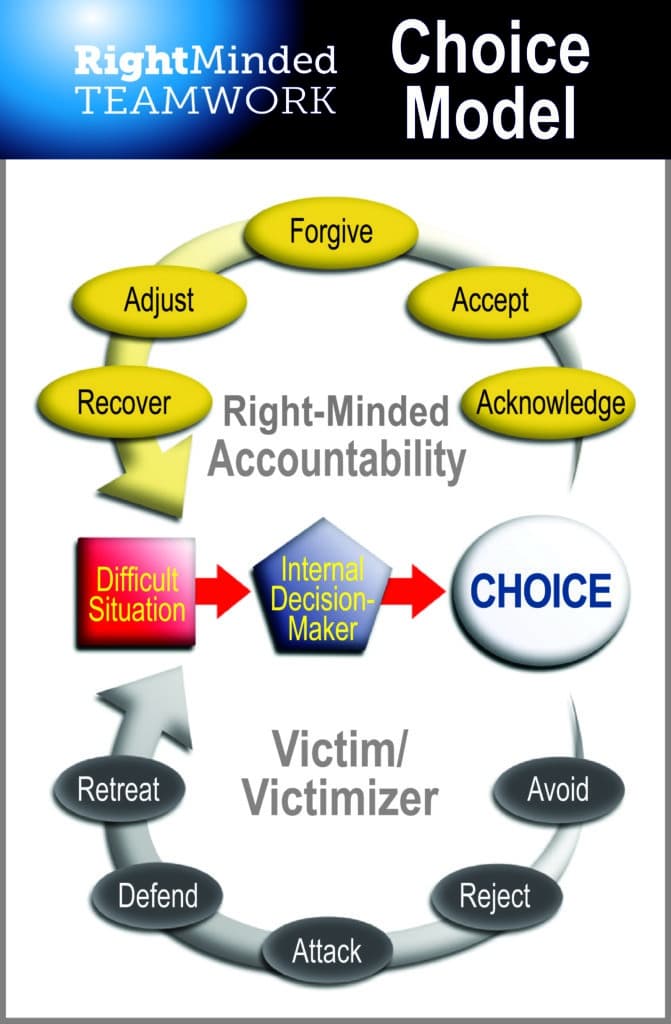
At the beginning of the workshop, you introduce the Right Choice Model. This is the mental map that helps the team agree to “let agreements replace all difficult team situations.”
When you ask the opening question in Step 4, your role shifts from “teacher” to “facilitative observer.” You capture their behavioral answers in Step 5 and synthesize them into an Intention Statement in Step 6. This is the “big picture” promise—for example: “We will communicate respectfully with each other and our customers.”
Finding the Right Granularity: Step 8
This is where “fit-for-purpose” facilitation is applied. In Step 8, the team discusses their specific clarifications or conditions. If the team is already high-functioning, they may only need one or two conditions. If the team is in deep conflict, they may need more. Remember: it’s important to periodically ask: “If you truly lived this agreement, would you achieve your desired outcome?” If they say yes, you have found the right level of granularity. Don’t over-engineer it.
Interlocking Accountability: Step 9
Step 9 is important. You only need to create this “interlocking accountability” condition once. It answers the question: “What do we do if someone continues to break our agreement?” This ensures the agreement persists long after the initial workshop excitement fades.
Why Work Agreements Work
In my four-decade career facilitating over 500 teams, I’ve learned, like you have, that it isn’t a matter of IF conflict will happen, but WHEN. Work Agreements work because they are promises teammates make to themselves to transform non-productive behavior. There are two types of agreements that together create a sane and sustainable way to work. They are:
- Process Agreements define who does what.
- Behavioral Agreements define how we treat each other.
Your Next Steps

Get the Facilitator’s Package: My eBook Package includes the 266-page step-by-step guide and Reusable Word Documents, so you don’t have to start from scratch.
Watch the 2-minute video below
Let’s get started. You don’t have to be a “Master Facilitator” to begin; you just have to be willing to help your team choose a better way to work.

May Oneness be With You & Your Teammates 🙏
Dan Hogan, Certified Master Facilitator
