
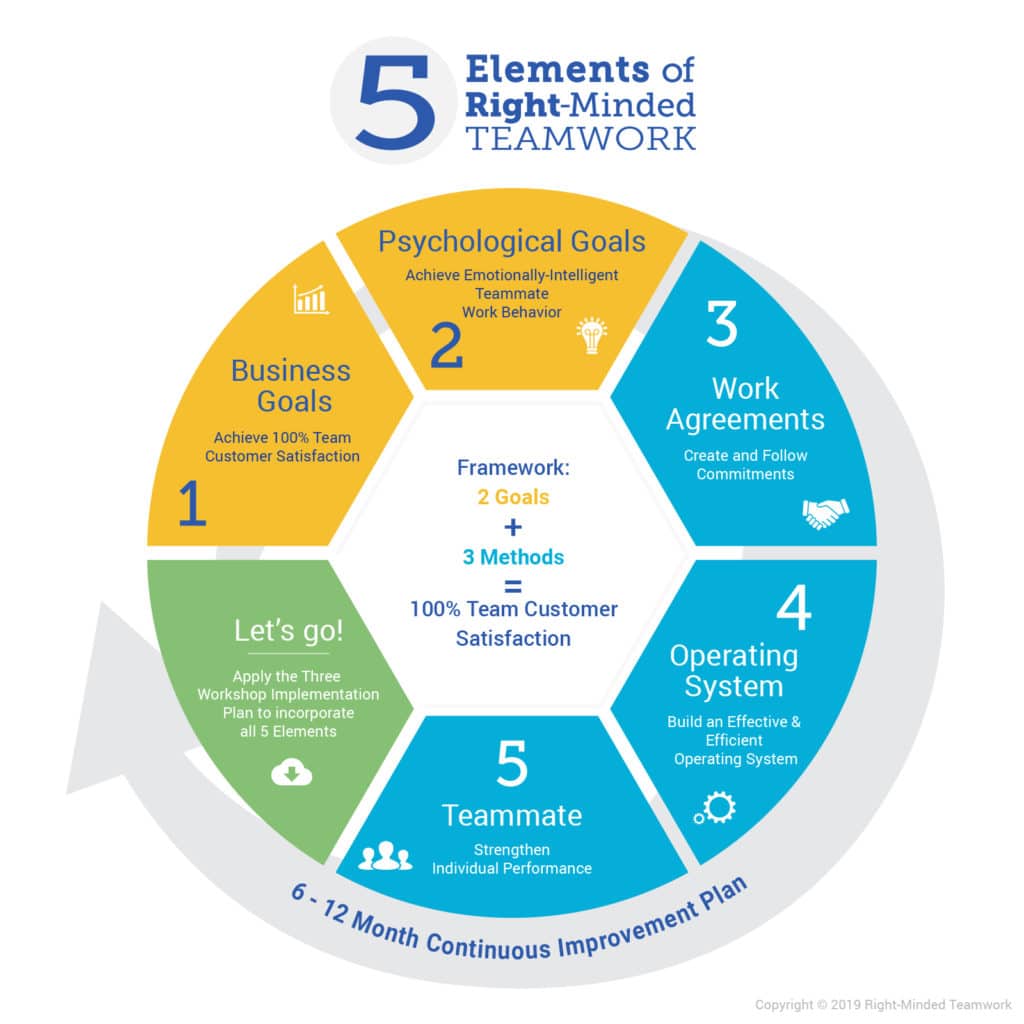
The Team Management System (TMS) is a strategic, enterprise-wide process designed to align all employee goals, attitudes, and work behaviors across an organization.
Its purpose is to ensure every team operates with clarity and focus, consistently working as one to achieve the organization’s vision, mission, and strategic goals.
The Right-Minded Teamwork® approach to the TMS is a real-world, team-building method that addresses and resolves real team issues, unlike ineffective practices like games or social events. It integrates the RMT 5-Element Framework into every team, treating team performance much like an employee performance management system but on a collective level. Teams set quarterly performance goals aligned with the organization’s strategic plan and report their actual results.
Core Philosophy and Participants
The TMS is founded on the RMT philosophy’s two universal truths:
- None of us is as smart as all of us
- Do No Harm, Work as One ®
Key groups involved in establishing and maintaining the TMS include the
- Executive Leadership Team,
- a dedicated TMS Steering Team,
- internal and external RMT Facilitators, and
- eventually, all teams across the enterprise.
The Executive Leadership Team holds a special TMS function: team transformation, which they achieve by strengthening their own Right-Minded Thinking and showing all leaders and employees, by example, how to do the same.
The Four Phases of TMS Deployment
The establishment of the TMS is a strategic planning process executed over four phases, eventually transforming the Steering Team into a permanent TMS department that ensures consistent, enterprise-wide results.
Phase 1: Launch (1 to 2 months)
The Executive Leadership Team applies RMT and officially launches the TMS. RMT is adopted as the organization’s standard teamwork process.
Phase 2: Pilot (4 to 6 months)
The Steering Team creates TMS 1.0, develops a team of RMT facilitators, and pilots the system in two or three teams. The system is fine-tuned into TMS 2.0.
Phase 3: Rollout (6 to 12 months)
The Steering Team measures the performance of the pilot teams and rolls out TMS 2.0 to a second, larger group of teams. Quarterly reports begin demonstrating beneficial enterprise results.
Phase 4: Permanent Establishment (6+ months)
The TMS is rolled out to all remaining teams. The Steering Team is transformed over the next one to two years into a permanent TMS department with established leadership, governance, and budget.
Benefits and Timeline
The deployment of the TMS yields significant organizational performance improvement:
- Benefits: The enterprise consistently achieves a higher percentage of its strategic goals year over year due to clarity and focus across all teams.
- Timeline: The system often begins paying for itself and showing organizational performance improvement within the first 6 to 12 months.
- Consistent, enterprise-wide results are typically reported within 18 to 24 months.
Action

To learn more, pick up a copy of Achieve Your Organization’s Strategic Plan: Create a Right-Minded, Team Management System to Ensure All Teams Work as One.
Download the ebook package here at Right-Minded Teamwork
Buy the Paperback Book Directly from Us, or at Amazon
