

Psychological Goals (Element #2) is the second element of the RMT framework that describes how teammates intentionally choose to think and behave as they work together to achieve their team’s Business Goals (Element #1).
In Right-Minded Teamwork (RMT), this element is crucial because the philosophy dictates that your thoughts precede and cause your work behavior. Therefore, choosing Right-Minded attitudes will naturally shift and improve teamwork.
This set of consciously chosen attitudes forms the team’s collective thought system, clarifying the principles and standards of behavior by which the team will Do No Harm and Work as One.
Committing to Right-Minded Attitudes
To achieve RMT, a team must first identify and agree upon a list of “right” attitudes that align with the organization’s stated values. These attitudes are captured in the team’s Work Agreements (Element #3).
A typical set of psychological goals focuses on accountability and the correction of mistakes:
- We accept 100% accountability and responsibility for our thoughts and behaviors.
- When we make mistakes, we never punish. We learn. We recover. We do no harm. We work as one.
- When difficult team situations happen, we accept, forgive, and adjust our attitudes and behavior.
- We are we-centered, never self-centered, believing that none of us is as smart as all of us.
The Two Response Choices
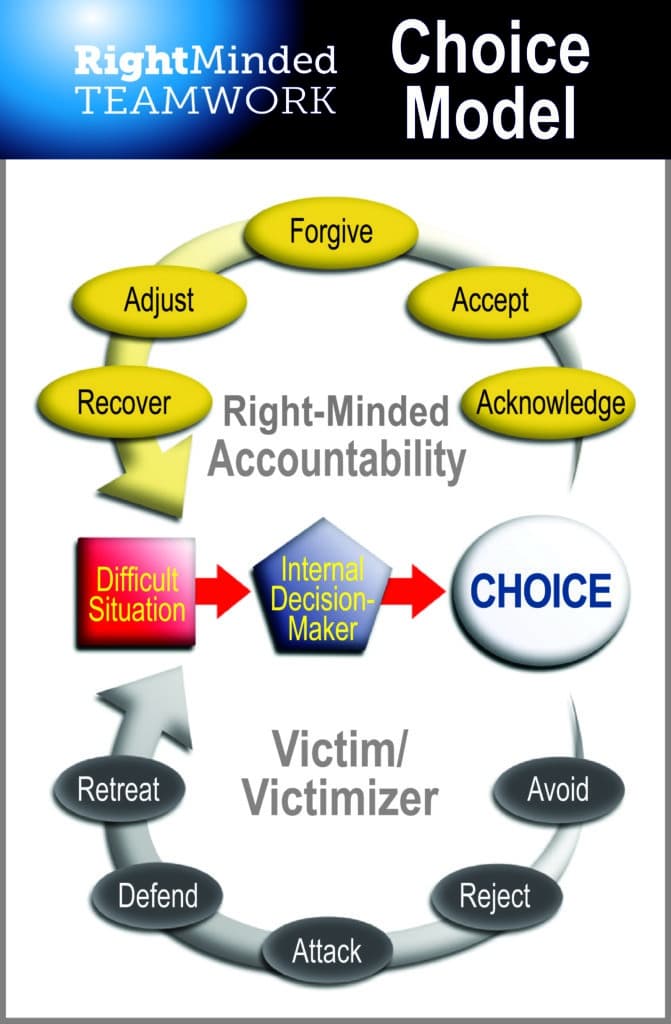
The underlying framework for defining psychological goals is the Right Choice Model, which asserts that the Decision-Maker (the observer, interpreter, and decider within every teammate) has only two response choices to every challenging situation:
- Follow Ego’s guidance: Act mindlessly, leading to blame, rejection, and defensiveness (the lower loop/divided circle).
- Embrace Reason’s guidance: Act mindfully and accountably, leading to Accepting, Forgiving, and Adjusting (the upper loop/Unified Circle).
Psychological Goals ensure the team is committed to the upper loop of the model.
Training the Mind to Choose Reason
Living the psychological goals requires mindful practice to train the mind to consistently choose Reason over Ego. The key to this training is:
- Seeking the Moment of Reason: When conflict arises, the mindful teammate stops and asks the question, “What did I do or say to create, promote, or allow this to happen?” This acceptance of responsibility initiates a Moment of Reason.
- Changing Perspective: By applying the RMT principle that “I am never upset for the reason I think,” teammates are empowered to reinterpret negative behaviors (like an Ego Attack) not as a personal assault, but as a call for help from a teammate. This perspective shift allows for a kind, forgiving response focused on correction, not punishment.
When a team commits to these psychological goals, they are creating their collective thought system and declaring their return to the Unified Circle of Right-Minded Thinking.
Action

To learn more about creating psychological goals, pick up a copy of these two books.
Right-Minded Teamwork in Any Team: The Ultimate Team-Building Method to Create a Team That Works as One. Psychological Goals are one of the 5 Elements of RMT’s Framework.
Download the ebook package here at Right-Minded Teamwork
Buy the Paperback Book Directly from Us, or at Amazon

How to Facilitate Team Work Agreements: A Practical, 10-Step Process for Building a Right-Minded Team That Works as One.
Download the ebook package here at Right-Minded Teamwork
Buy the Paperback Book Directly from Us, or at Amazon