
Interlocking Accountability is a crucial Right-Minded Teamwork (RMT) concept that serves as a vital safeguard for a team’s Work Agreements.
It defines, ahead of time, a mutually agreed-upon method for how teammates will compassionately confront a peer who continues—either by mistake or intentionally—to break the spirit or letter of the team’s Work Agreements. This condition is formally established in Step 9 of the RMT 10-Step facilitation process.
Definition and Purpose
Interlocking Accountability is far more than just “policing” a teammate; it is the compassionate method that ensures the commitments made in the Work Agreements are honored. It involves:
- Positive Reinforcement: Giving praise when teammates consistently live their Work Agreements.
- Supportive Confrontation: Providing firm but caring feedback for continued breaches, ensuring a safe and non-punitive environment.
- Mutual Ownership: Being accountable to each other for achieving the desired outcome of the Agreements.
- Learning from Mistakes: Strengthening team trust by focusing on recovery rather than denial or punishment.
The Accountability Question
The core of Interlocking Accountability is the creation of a condition statement that answers one critical question:
“If someone continues to break this Work Agreement, what will we do?”
RMT emphasizes that teams must not skip this step. Without this defined condition, teams are far less likely to recover when agreements are broken, often leading to the eventual abandonment of the entire RMT process.
The resulting statement ensures that confronting a repeat offender is a pre-agreed-upon team action, not an arbitrary personal attack. The solution might involve seeking support from a neutral third party or a higher authority to facilitate resolution, ensuring the focus remains on correction and recommitment rather than blame.
Living the Agreements
While creating Work Agreements is the equivalent of “saying the words,” Interlocking Accountability enforces the principle that living these words means everything.
This condition should be defined in at least one of the team’s first Work Agreements, as it is designed to apply to all subsequent Agreements. Having this proactive method in place helps prevent repeat offenses and allows the team to heal and move on, moving closer to the goal of consistently living the Do No Harm. Work as One. philosophy.
Action
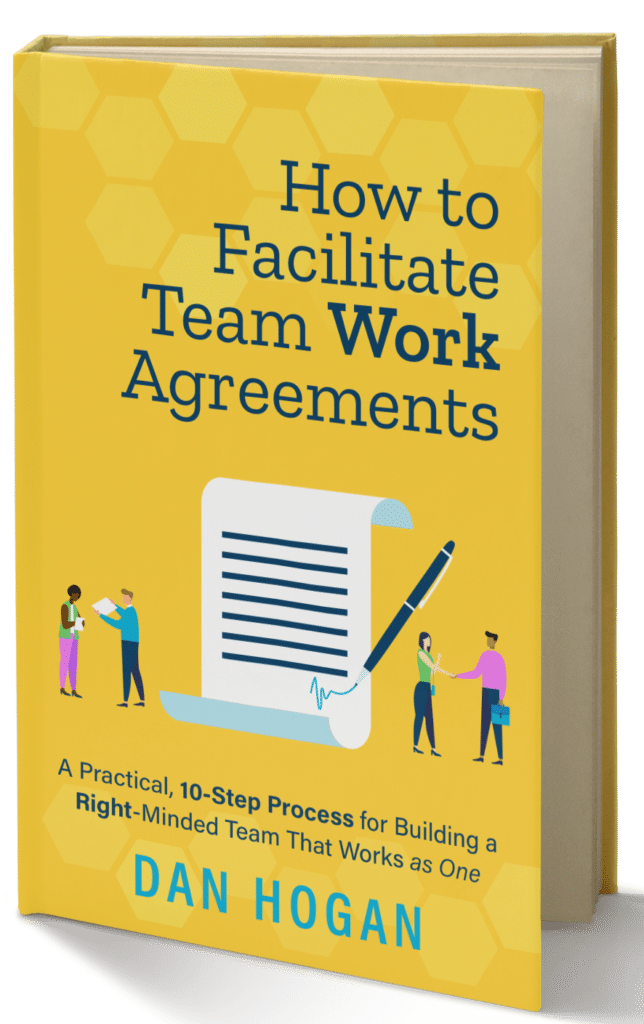
Download the ebook package here at Right-Minded Teamwork
Buy the Paperback Book Directly from Us, or at Amazon
