The Team Operating System is the fourth element of the RMT framework, designed to make a team’s functions effective and efficient to achieve the team’s Business Goals (Element #1).
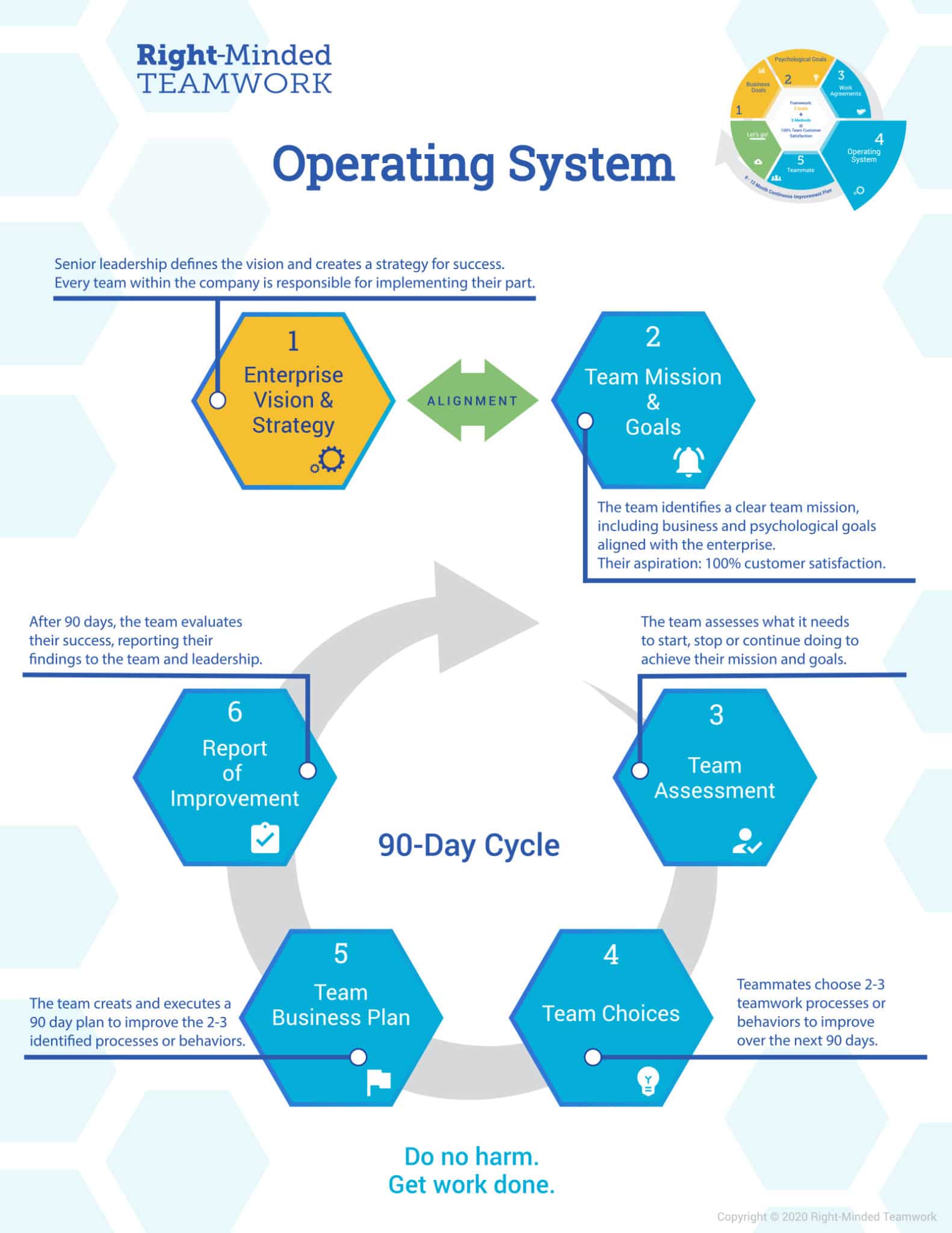
It is a six-step, 90-day continuous improvement plan—a systematic process that organizes a team’s functions to ensure they consistently work toward achieving 100% customer satisfaction. The system is designed to gain speed and momentum after the first few iterations, eventually becoming second nature.
The Six-Step Continuous Improvement Cycle
The system connects the organization’s strategy to specific, measurable team action and quarterly accountability. The process is repeated every 90 days:
- Enterprise Vision & Strategy: The team understands and commits to its accountability for implementing its part of the senior leadership’s vision and strategy.
- Team Mission & Goals: The team defines its own mission, business goals, and psychological goals with focused energy and resources.
- Team Assessment: The team uses the Team Performance Factor Assessment (25 factors) to identify its two to three most critical improvement opportunities for the upcoming 90 days.
- Team Choices: The team determines its critical few projects, deliverables, or initiatives and selects one or more of RMT’s Three Team Improvement Strategies to implement solutions.
- Team Business Plan: All team choices, projects, and the team’s vital Decision-Making Work Agreement are captured in the Team Business Plan, which guides and tracks efforts over the 90 days.
- Report of Improvement: The team re-administers the assessment to calculate actual performance improvement, captures lessons learned and best/worst practices, and presents the Report of Improvement to its sponsor. The team then confirms alignment and begins the cycle again.
The Decision-Making Work Agreement
A core component of the Team Operating System is the Decision-Making Work AgreementEvery team needs a Decision-Making Work Agreement that clearly defines how decisions are made and who makes them. More (Factor #18 in the assessment), which clearly defines how decisions are made and who makes them. This agreement outlines four options:
- Command: The leader makes the decision and announces it. This option is suitable for emergencies and inconsequential decisions, where teammates happily abide by the leader’s choice.
- Consult: The leader gathers input but makes the final decision. Teammates commit to abiding by the announced choice.
- Consensus: The team desires mutual support. All agree to support the decision actively, even if it wasn’t their first choice. This option requires a pre-agreed fall-back plan to prevent deadlocks, embodying the RMT focus: “None of us is as smart as all of us.”
- Delegation: The leader gives the team or a subgroup the authority to decide within specific guidelines/boundaries. The leader and other teammates commit to abiding by the delegated group’s decision.

Maria’s Case Study: A Real-World Example
Maria’s Case Study details how a successful team leader applied the Right-Minded Teamwork Operating System to transform a struggling team in just 12 months. This comprehensive case study provides field-tested, real-world lessons (no games) for transforming any team from the “storming” phase into a high-performing unit.
Action

To read Maria’s Case Study, click here.
To learn the process, pick up your copy of Right-Minded Teamwork in Any Team: The Ultimate Team-Building Method to Create a Team That Works as One.
Download the ebook package here at Right-Minded Teamwork
Buy the Paperback Book Directly from Us, or at Amazon